6a, 57 Miller Street Murarrie QLD 4172


Executive summary
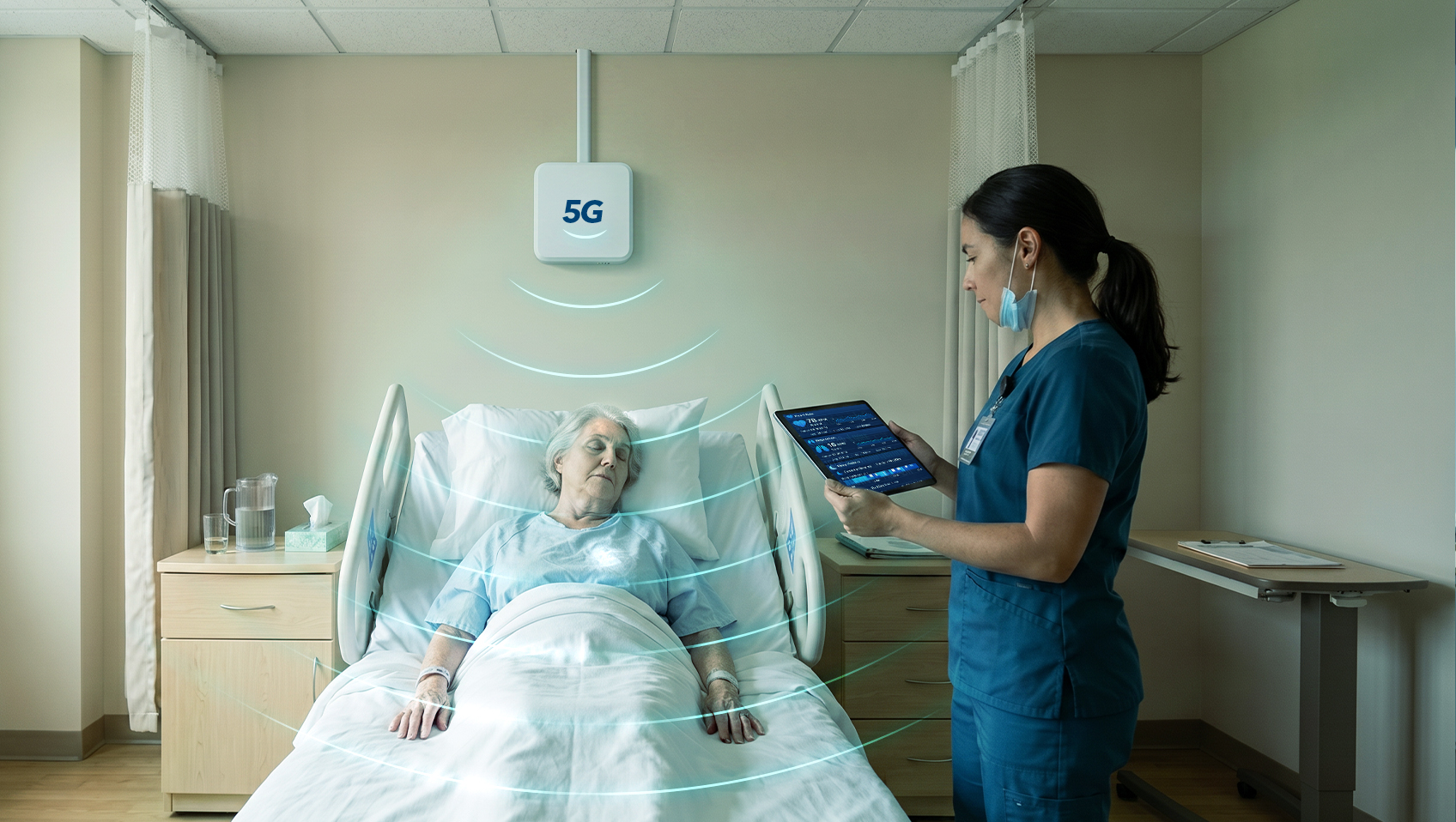
5G in healthcare is usually considered as having devices and systems connected in a faster and more reliable manner. Emerging research suggests that it may be able to serve a broader role in the safety of patients. Studies by industry leaders have proved that 5G signals can successfully support passive, device-free sensing of human activity, including respiration and sleep-related movement. For Australian institutions, the relevance is paramount, both enabling higher standards of care and alleviating pressure from regular in-person monitoring.
Aged Care
Aged care providers face a persistent challenge: improving safety and overnight visibility without unnecessary intrusion or reliance on wearables that residents may not tolerate. Passive sensing supported by wireless infrastructure could, over time, help supplement existing observation routines by highlighting unusual patterns enabling a proactive approach to patient care. Importantly, this would not replace care staff or clinical judgement but could support more exception-based workflows in appropriate settings.
Private Hospitals
In private hospitals, regulated clinical monitoring will remain central. However, non-contact sensing could add value in selected lower-acuity areas, recovery spaces, or environments where additional visibility is useful but traditional monitoring would be disproportionate. In these contexts, infrastructure-led sensing may provide a lightweight supplementary layer rather than a primary clinical tool.
Commercial And Operational Realities
The research also highlights practical limits. Performance varies depending on room layout, wall materials, signal paths, and device placement. As 5G technologies are founded on radio frequencies (RF) it makes it clear that any future use of 5G sensing is thee-fold; radio-design, governance and technology innovation.
Radio-design entails mapping rooms and common spaces for optimised signal propagation. This would be accomplished in a similar way to wireless-design, a scan can be taken that maps high-frequency signals for interference that can be used to optimise signal strength.
Like many emerging technologies that usher in economic and societal value, passive monitoring requires careful governance to mitigate risks. Organisations considering these technologies must consider privacy implications, consent, cybersecurity strategies, and regulatory exposures.
While 5G matures, the evolution toward 6G technology introduces unprecedented accuracy and functional scope for passive monitoring. By utilizing the sub-terahertz spectrum, 6G architectures establish a unified platform that integrates high-speed communication with environmental sensing. These unique spectral characteristics allow the network to serve as a sophisticated sensor, effectively merging data transmission and physical awareness into a single infrastructure.
As a leader what can you do
Healthcare leaders can begin by asking where passive sensing might genuinely add value, whether their infrastructure and operating models are mature enough to support pilots, and how such capabilities would complement existing systems. For Australian providers in particular, balancing safety, dignity, and compliance will be central to any exploration.
Conclusion
5G in healthcare is often described as a faster pipe. Emerging evidence suggests it may eventually become something more: a shared infrastructure layer that supports connectivity, insight, and selective observation. For aged care campuses and private hospitals, this is not yet a mature product category, but it is a credible signal worth understanding and optimistically monitoring.