6a, 57 Miller Street Murarrie QLD 4172


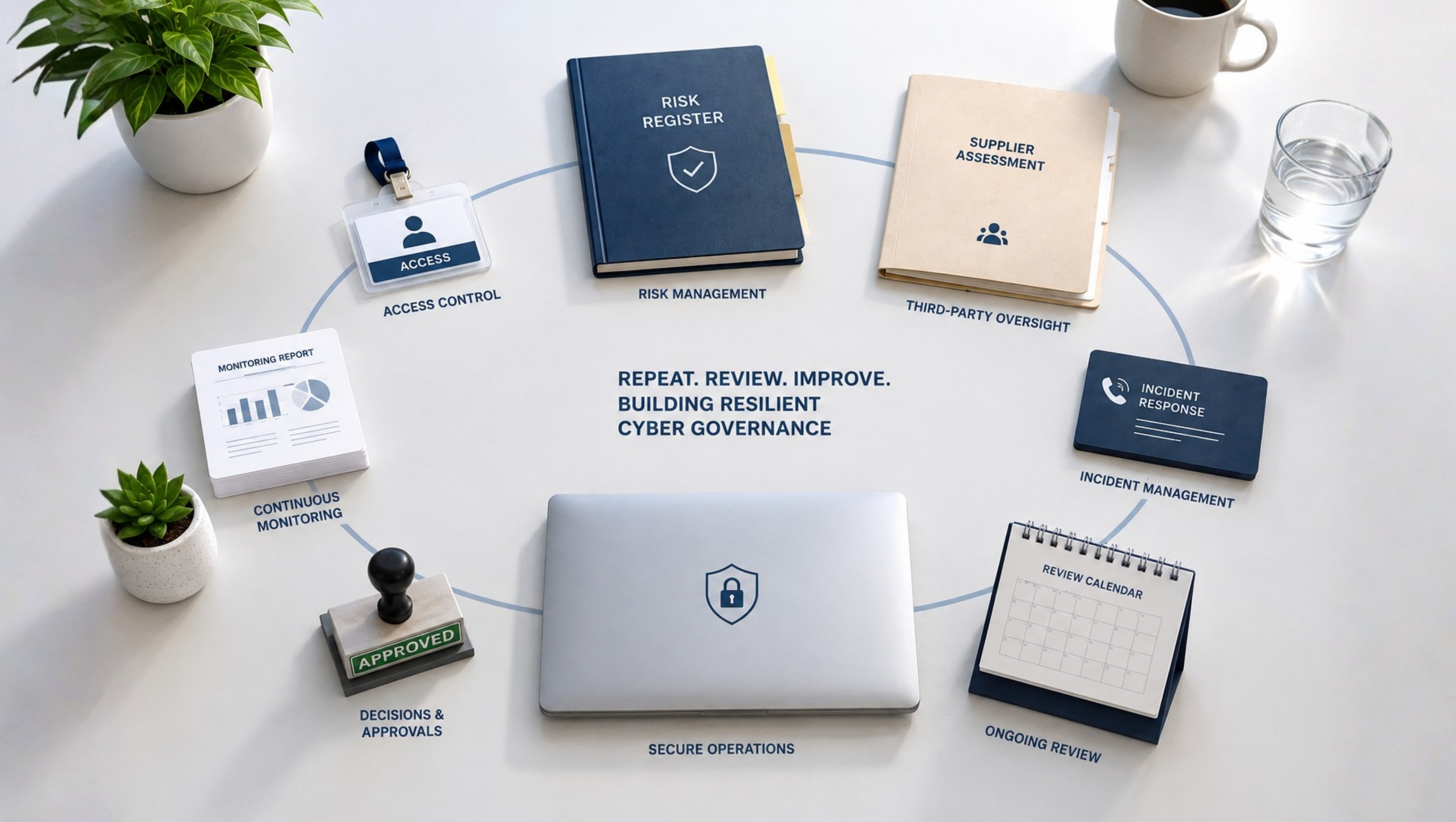
Many organisations invest heavily in cyber security policies, frameworks, compliance initiatives and technology platforms. Yet despite this investment, leaders often remain uncertain whether their cyber governance is actually improving.
The reason is simple.
Good cyber governance is not created by policies, frameworks or reporting in isolation. It emerges when these elements are integrated into repeatable business processes that operate consistently across the organisation.
Policies define intent. Processes deliver outcomes.
This distinction matters because governance is frequently misunderstood as a documentation exercise. Boards approve policies. Management adopts frameworks. Security teams produce reports. Technology generates alerts.
Each activity has value.
However, none of them independently creates governance.
A policy that is never referenced in operational decision-making is simply a document. A monitoring platform that produces thousands of alerts without a defined response process creates noise rather than oversight. A board report that identifies risks without assigning ownership and accountability rarely results in meaningful action.
Governance exists when these elements become part of the way an organisation operates.
Consider access management. Most organisations maintain a policy describing how access should be granted, reviewed and revoked. Effective governance occurs when that policy is embedded in onboarding procedures, offboarding workflows, approval mechanisms, periodic access reviews, monitoring activities, exception management and executive reporting.
The policy establishes the expectation.
The process ensures the expectation is consistently achieved.
The same principle applies throughout cyber security.
Risk management depends on processes that identify, assess, treat and reassess risk over time. Incident management depends on processes for escalation, decision-making, communication and recovery. Third-party risk management depends on processes that assess suppliers, monitor compliance obligations and periodically review contractual commitments.
Without process, governance becomes theoretical.
With process, governance becomes measurable.
This is one of the characteristics that consistently separates digitally mature organisations from those still struggling to manage cyber risk. The most successful organisations are not necessarily those with the largest security budgets or the most sophisticated technology stacks. They are the organisations that have embedded cyber security into their operational rhythms and governance structures.
People understand their responsibilities. Accountability is clear. Decisions follow defined pathways. Management receives meaningful information. Boards receive reporting that links cyber risks to business outcomes. Metrics drive improvement. Reviews drive action.
In these organisations, cyber security is not treated as a standalone technical function.
It becomes part of how the organisation operates.
Ultimately, mature cyber governance is less about the technologies an organisation deploys and more about the repeatable processes that connect people, decisions and controls. Technology remains important, but its value is only realised when supported by disciplined organisational processes.
The organisations that achieve lasting cyber resilience understand this principle well.
They do not govern through policies alone.
They govern through process.